For homeowners in Bedfordshire, the transition between indoor living space and the garden is a critical architectural junction. Whether you are overlooking the rolling hills of the Chilterns or a manicured lawn in a Biggleswade new build, the installation of French doors is one of the most effective ways to enhance natural light and property value.
However, from a professional installation perspective, French door installation is far more than a simple aesthetic upgrade. It is a technical exercise in structural integrity, thermal performance, and legal compliance. In this guide, we draw on over 30 years of experience in Bedfordshire windows and doors to detail the realities of professional fitting, the shifting landscape of UK building regulations, and how to ensure your investment stands the test of time.
The Search Intent: Why Professional Installation Matters
Most Bedfordshire property owners begin their journey looking for “French doors Bedfordshire” with a focus on style. Yet, the search intent quickly shifts toward technical viability: Can my existing lintel support the weight? Will these doors meet the 2026 energy standards? Do I need a FENSA certificate?
Professional installation addresses these questions by treating the door as a “controlled fitting.” Under UK law, any external door replacement must meet specific criteria regarding heat loss, safety glazing, and ventilation. Failure to account for these during the planning stage can lead to issues with local building control or complications when eventually selling the property.
Strategic Decision-Making: Material and Glazing Selection
Choosing the right material is the first strategic hurdle. In Bedfordshire’s varied property market-ranging from Victorian terraces in Bedford to modern garden room French doors in rural extensions-the material must balance durability with local aesthetic expectations.
| Material | Best For | Thermal Efficiency (U-Value) | Maintenance |
| uPVC | Modern builds & rentals | Excellent (often < 1.2) | Very Low |
| Aluminium | Large apertures & slim sightlines | High (with thermal breaks) | Low |
| Engineered Timber | Period properties & listed areas | Natural Insulation | Medium (Requires painting/staining) |
Glazing Considerations:
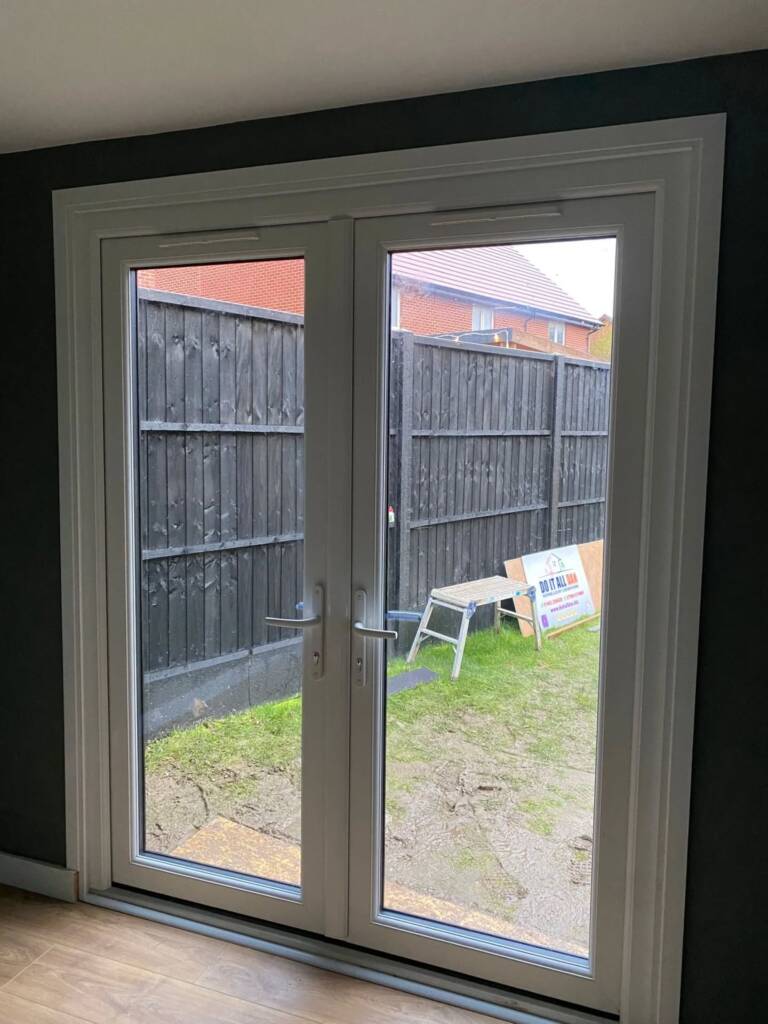
To comply with UK Government Building Regulations, any glass within 1500mm of the floor level must be toughened safety glass. For 2026 standards, we increasingly recommend Low-E (low emissivity) coatings and argon-filled units to achieve the required thermal performance. If your project involves developer French door installation for a new build, you may even be looking at triple glazing to meet the stringent “Future Homes Standard” targets.
Legal Compliance: FENSA, Part L, and Beyond
Navigating the legalities of installation is where a specialist’s experience becomes invaluable. In the UK, every window and door installation must be registered with the local authority.
- Part L (Thermal Performance): As of recent updates, replacement doors must typically achieve a U-value of 1.4 W/m²K or better. This measures the rate of heat transfer; the lower the number, the better the insulation.
- Part F (Ventilation): If your original doors had trickle vents, your new ones must have them. Even if they didn’t, current regulations often require the addition of background ventilation to prevent internal damp and mould.
- Part Q (Security): For new dwellings, doors must meet PAS 24 standards, proving they can resist physical attack from opportunistic intruders.
- FENSA Certification: Choosing a FENSA-registered installer means the company can “self-certify” that the work complies with Building Regulations. You will receive a certificate that acts as vital proof of compliance for your Energy Performance Certificate (EPC) and future solicitors.
Case Study: A Victorian Refurbishment in Ampthill
To illustrate the complexities of a real-world project, consider a recent installation we managed for a Victorian home in Ampthill. The homeowner wanted to replace a failing timber set with modern, high-performance French doors in Bedfordshire.
The Challenge: The original opening was “out of square” by nearly 15mm, a common issue in period UK properties. Simply “dropping in” a standard-sized frame would have resulted in uneven gaps, leading to drafts and eventual frame warping.
The Solution:
- Structural Survey: We identified that the existing timber lintel was showing signs of deflection. Before installation, a new steel catnic lintel was required to support the brickwork above.
- Bespoke Manufacture: The frame was manufactured with “add-on” profiles to compensate for the uneven masonry while maintaining a level threshold.
- Weather Sealing: Given the exposed location, we utilised a multi-point locking system and EPDM flexible membranes to ensure a watertight seal against the driving rain common in the East of England.
Day-to-Day Installation Realities: What to Expect
Understanding the “fitting day” helps manage expectations and reduces disruption. A standard French door installation typically takes one full day, assuming no major structural surprises.
- The Survey: This is the most critical step. A professional surveyor won’t just measure width and height; they check for floor levels (to ensure the doors don’t “drag”), internal plaster lines, and external drainage.
- Access and Preparation: Installers need a clear 2-metre radius inside and outside the door. If you are installing garden room French doors, ensure there is a stable path for carrying heavy glass units.
- Weather Factors: While we can install in light rain, high winds can make handling large glass panes dangerous. A reputable Bedfordshire installer will always monitor the forecast and communicate if a delay is necessary for safety.
- The “Clean Down”: Professional fitting includes the removal and ethical disposal of your old doors, as well as “making good” the plasterwork around the new frame.
Managing Common Installation Issues
Even with the best planning, UK properties-especially those in Bedfordshire’s clay-heavy soil-can present challenges.
Expert Tip: Watch out for “Threshold Creep.” In many older UK homes, the internal floor level is higher than the external patio. If the installer doesn’t account for this, you may end up with a high “step-over” that is both a trip hazard and non-compliant with Part M (Access) of the building regs.
Common issues include:
- Sub-floor Instability: If the doors are being fitted into a new extension, the slab must be fully cured to prevent the frame from dropping.
- Bridge Cavities: It is essential to maintain the cavity closer to prevent “cold bridging,” where moisture condenses on the cold internal surface of the wall.
- Hardware Alignment: French doors have a “master” and a “slave” door. If the hinges aren’t adjusted perfectly, the multi-point locks will feel “notchy” or stiff, eventually leading to mechanical failure.
Value Comparison: Long-Term ROI
For property developers and landlords, the decision often comes down to the balance between initial outlay and long-term yield. High-quality Bedfordshire windows and doors contribute significantly to a property’s “kerb appeal” and its EPC rating.
| Feature | Low-Cost “DIY” Grade | Professional Specialist Grade |
| Locking System | Single-point or basic deadbolt | 5-point Yale or Ultion locking |
| Glass Specification | Standard Double Glazing | Argon-filled, Low-E, 28mm units |
| Warranty | Limited 1-year parts | 10-year insurance-backed guarantee |
| Certification | None (requires Building Control fee) | FENSA/Certass included |
Investing in professional French door installation ensures that the “operating force” required to open the doors remains low and the thermal seal remains tight for decades, not just seasons.
Why Choose Design a View for Your Bedfordshire Project?
At Design A View, we bring over 30 years of hands-on experience to every project across Bedford, Luton, and the surrounding villages. We understand that a French door is a gateway to your home’s outdoor space, and it must be as secure as it is beautiful. Our team handles everything from the initial technical survey to the final FENSA approved and CPA approved company registration, ensuring your installation is fully compliant with the latest UK Building Regulations.
Whether you are a developer looking for a reliable partner for developer French door installation or a homeowner wanting to breathe new life into your lounge, we provide the technical expertise required for a flawless finish.
Frequently Asked Questions
In most cases, replacing existing doors or windows with French doors falls under “Permitted Development” and does not require planning permission. However, if you live in a Conservation Area (such as parts of Ampthill or Woburn) or a Listed Building, you must seek advice from Bedford Borough or Central Bedfordshire Council before proceeding.
Under current Part L regulations, replacement external doors must achieve a U-Value of at least 1.4 W/m²K. For new extensions or new builds, the requirements may be stricter, often aiming for 1.2 W/m²K or lower to align with the Future Homes Standard.
For a standard replacement where the aperture is already prepared, the installation usually takes between 4 to 6 hours. This includes removing the old set, fixing the new frame, glazing, and sealing. Structural modifications, such as widening an opening, will extend this timeframe to 2 or 3 days.
A FENSA certificate proves that your French door installation complies with Building Regulations and has been registered with the local authority. You will need this document when selling your home to prove the work was legal and meets energy efficiency standards.
Yes, garden room French doors are a popular choice. However, because garden rooms are often lighter structures, it is vital to ensure the “header” (the beam above the door) is strong enough to prevent the roof weight from bowing the door frame, which would cause the doors to stick.